
UK Basketball Live Betting Tips: Maximize In-Play Returns
 Available in US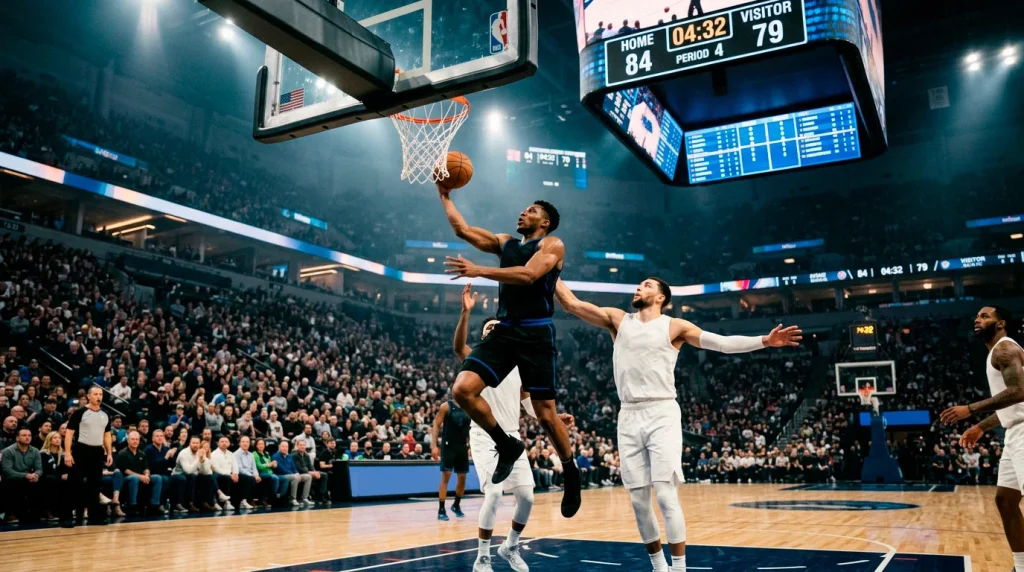
Live betting accounts for 52 to 60% of all basketball wager volume on mature European platforms, and that number keeps climbing. I started my career analysing pre-match markets, but the action — and the edge — has migrated in-play. Basketball is uniquely suited to live betting because of its scoring frequency, predictable momentum patterns, and the sheer number of stoppages that give you time to think. The trick is knowing what to look for and, just as critically, when to hold back.
When trading in-play, knowing the exact basketball cash out rules can help you lock in profits before a late-game momentum shift ruins your ticket.
Momentum Shifts: Extracting Value from Live Betting Odds
Every experienced basketball bettor has a “momentum story” — a game where they watched one team go on a 15-0 run and the market overcorrected in real time. My most memorable was a second-round playoff game where the trailing team was down 18 at halftime, the live moneyline stretched to 8.50, and they won by 6. The market had written them off too quickly.
Momentum in basketball is real, but it is also cyclical. NBA games rarely sustain a one-sided scoring run for more than four or five minutes. The structure of the sport — shot clock, substitutions, timeouts, free throws — creates natural breaking points that reset momentum. When one team goes on a 12-0 run, the live odds swing sharply in their favour. But history shows that the opposing team almost always responds with a run of their own, and the market frequently overshoots during the initial swing.
The practical application is straightforward: when you see a major scoring run shift the live odds dramatically, wait. Watch for the responding run before placing your bet. If the trailing team calls a timeout, makes a substitution, or simply gets a stop and a score, the live line will start correcting back. Your window is the gap between the momentum peak and the correction — that is where the value lives.
Tracking possession efficiency in real time helps quantify what your eyes are telling you. If a team’s run was fuelled by three consecutive turnovers by the opposition rather than exceptional shooting, the run is less likely to sustain. Turnovers are unstable; shooting streaks can be, too, but a team converting at 80% on a six-possession stretch is far more likely to be experiencing a hot streak than a permanent shift in quality.
Suspension Windows and Market Reopenings
Adam Silver once noted that the NBA is still learning as it goes when it comes to working with betting companies and putting controls in place — and nowhere is that more visible than in the mechanics of live market suspensions. Sportradar, which holds official data rights for over 900 sports organisations globally, provides the feeds that power most UK bookmakers’ in-play pricing engines. When the feed flags an event — a foul, a timeout, a challenge review — markets suspend.
These suspensions create distinct windows for the alert bettor. Most markets reopen within 10 to 30 seconds of a standard stoppage. During that window, you cannot place a bet, but you can observe what has changed — a key player picking up a foul, a coach making a tactical substitution, or an injury becoming apparent. When markets reopen, the new odds reflect the bookmaker’s model adjustment, but the model cannot capture everything you have seen. If you noticed the starting centre limping during the timeout, the live totals line may not have adjusted for his reduced mobility. That gap between what the model knows and what you know is the edge.
Free-throw situations create particularly useful suspension-reopening cycles. Markets suspend when a foul is called and reopen after the free throws are taken. The few seconds between the foul call and the free-throw attempt are dead time for the market but live time for your analysis. Is the shooter a 90% free-throw shooter or a 55% one? If a poor free-throw shooter is at the line in a tight game, the live spread may shift less than it should after a miss — and that is your entry point.
Micro-Betting: Next Possession and Next Basket Markets
Micro-betting exploded by 214% year on year in 2024 and now represents 38% of all in-play bets on major platforms. These are the fastest-resolving bets in basketball: who scores the next basket, whether the next possession results in a made field goal, what the next scoring play will be (two-pointer, three-pointer, or free throw).
I approach micro-bets differently from traditional in-play markets. Traditional live betting rewards game-level analysis — momentum, matchups, fatigue. Micro-betting rewards possession-level reads. Who has the ball? What is the likely play call coming out of a timeout? Is the offence in transition or running a half-court set? The answer to these questions changes every 24 seconds, and so does the optimal bet.
The risk with micro-betting is velocity. The pace at which you can place, win, lose, and place again is dramatically faster than standard live betting. I have seen bettors cycle through 30 micro-bets in a single quarter without realising how much total volume they have wagered. The per-bet stakes tend to be small, which creates an illusion of low risk, but the cumulative exposure adds up rapidly. If you explore micro-betting, set a session limit before the game starts and track your total wagered, not just your per-bet amount.
The mathematical edge on micro-bets is thinner than on traditional markets because the bookmaker’s margin is higher on rapid-resolution bets. You are paying a premium for speed and entertainment, and the vigorish on next-basket markets is typically 8 to 12% compared to 4 to 6% on standard moneyline or spread markets. Knowing this does not mean you should avoid micro-bets, but it does mean you should recognise them for what they are: high-frequency, high-margin betting products where discipline matters more than analysis.
Execute your in-play strategies with zero latency by choosing a trusted basketball betting platform from our recommended list.
Cash Out Timing in Basketball
For a detailed breakdown of how cash out calculations work across different UK operators, see the full cash out rules guide. The core principle for live basketball betting is that cash out timing directly tracks momentum — when your bet is in a strong position, the cash-out value peaks, and the temptation to lock in profit is highest. That temptation is by design.
My general approach to cash out in live basketball is conservative: I use it only when new information has emerged that was not available when I placed the original bet. A key player injury, an unexpected ejection, or a tactical shift that fundamentally changes the game dynamic — these are legitimate reasons to reassess and take a cash out. A temporary scoring run by the opposing team is not, because temporary runs are the norm in basketball, and cashing out during a momentum swing means selling your position at its lowest value.
Articles
Written by the editors at CourtEdge.
