
UK Basketball Betting Rules: Compare Markets and Top Sites
 Available in US
Nine years of analysing basketball betting lines has taught me one thing above all else: the rules that govern how your bet is settled matter more than the odds themselves. I have watched sharp bettors lose money not because they picked the wrong side, but because they did not understand what happens when the fourth quarter ends tied and overtime begins. I have seen accumulators collapse because one leg voided on a technicality that was spelled out in the bookmaker's terms — terms almost nobody reads.
Basketball betting is a global market valued at $8.7 billion and growing at nearly 9% year on year. In the UK alone, roughly 10% of the adult population places sports bets online, generating close to 290 million wagers every single month. That is an enormous volume of money moving through systems governed by rules most punters never study. The NBA dominates — accounting for around 60% of worldwide basketball betting revenue — but EuroLeague, the British Basketball League, WNBA and NCAA March Madness all have their own settlement logic, their own quirks, and their own traps for the uninformed.
This guide covers every major market type, the settlement rules that decide your payout, live betting mechanics, UKGC protections, and the integrity landscape that shapes what you can and cannot wager on in 2026. I built it because the top search results for basketball betting in the UK are either affiliate reviews pushing sign-up bonuses or dry legal pages written for compliance officers — and neither helps the bettor who needs to understand why their handicap bet lost when their team won.
Whether you are placing your first NBA moneyline or building same-game parlays across European leagues, the principles here give you the structural knowledge that separates informed bettors from everyone else. The edge starts with understanding the rules.
Basketball Betting Analysis: Leveraging Market Data
- Overtime counts for moneyline, handicap and totals but not for quarter-specific or three-way markets. This single rule causes more settlement confusion than any other.
- The global basketball betting market is worth $8.7 billion, with the NBA commanding 60%. UK viewership on Prime Video surged 444% in the 2025/26 season.
- UKGC Financial Risk Assessments affect only 3% of customers, and 97% of those clear automatically.
- Live betting accounts for 52–60% of handle in mature European markets. Micro-betting grew 214% in 2024.
- Settlement rules vary between bookmakers — verify push policies, void conditions and overtime treatment before you bet.
CourtEdge model · overtime & push clauses
Settlement Exposure Meter
Every basketball bet has a slice of its outcomes that is decided by the settlement terms — overtime inclusion and the push rule — and not by the basketball. This measures that slice for the game in front of you, and prices what it is worth.
Outcome space for Handicap — favourite, drawn to scale
- Decided on court — won 0
- Decided by the clause 0
- Decided on court — lost 0
Overtime at this line
—
Settled by the terms
—
What the clause is worth
—
The clause is not a constant
Bookmakers quote one overtime rule for every game. Its weight moves with the handicap, because overtime can only start from a tie.
Same game, seven markets
One calibrated regulation model, read through each market's own settlement rule.
| Market | OT counts | Settled by terms | Clause effect | Fair price |
|---|
Model, not a feed. Margins and totals are treated as normal around a regulation mean calibrated so that the handicap and the total you entered are both 50/50 under overtime-inclusive settlement; the tie is inflated above the normal density because late-game fouling and last-shot play manufacture level scores; extra periods compound geometrically. Rule treatments follow the standard UK terms — overtime included on moneyline, handicap, totals and player props, excluded on quarter and half markets — and individual operators vary, so read your own bookmaker's basketball rules. Informational only. 18+, please gamble responsibly.
How Basketball Betting Works in the UK
A mate of mine — lifelong football punter, never touched basketball — placed his first NBA bet last January during the London Game at the O2. He backed the over on total points, watched the game sail past his line by the third quarter, and collected his winnings before the final buzzer. "That was easy," he told me. It took him about three more bets before the reality hit: basketball betting operates under a completely different logic to the football markets he had spent years learning. The scoring pace, the overtime rules, the way handicaps function — all of it felt familiar on the surface and foreign underneath.
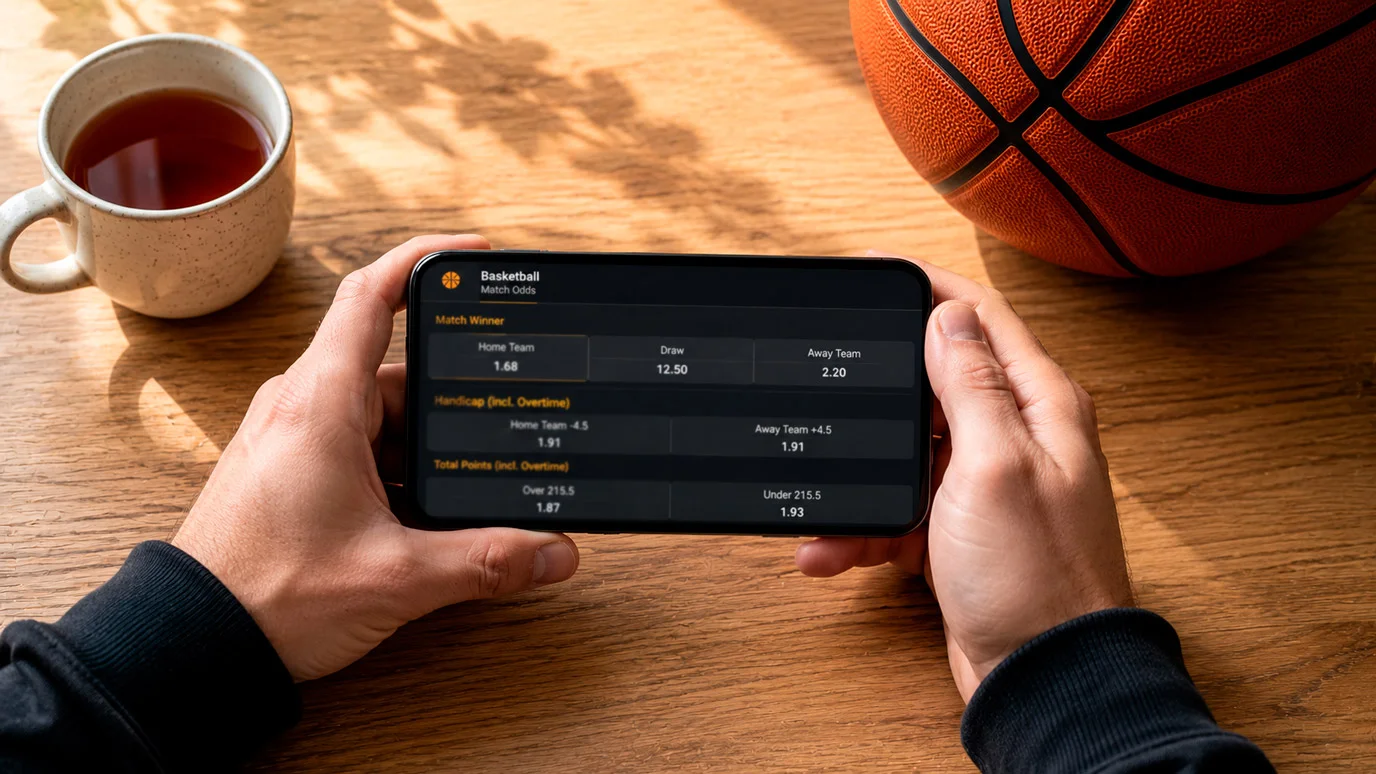
The UK betting landscape for basketball sits within a tightly regulated framework. The UK Gambling Commission oversees every licensed operator, and the industry generates substantial revenue — the online betting sector alone produces approximately GBP 16.8 billion in Gross Gambling Yield annually. Basketball occupies a growing but still secondary position behind football in UK wagering, which means the market depth and rule standardisation you find for Premier League matches does not always exist for an NBA Tuesday night slate or a EuroLeague round.
Regulated environment
All legal basketball betting in the UK occurs through UKGC-licensed operators. Unlicensed sites offer no dispute resolution, no self-exclusion tools and no guarantee your funds are protected.
Market availability
NBA games typically carry 100+ markets per fixture at major bookmakers. EuroLeague and BBL coverage is thinner — expect 20–40 markets for top EuroLeague fixtures and sometimes fewer than 15 for BBL.
Settlement timing
Most pre-match basketball bets settle within minutes of the final buzzer. Player props and statistical markets may take longer if the bookmaker waits for official stat confirmation.
Odds formats
UK bookmakers default to decimal odds for basketball. Fractional odds are available but less practical for the precise margins basketball lines require. American odds appear on US-sourced content and need conversion.
The mechanics are straightforward in theory. You select an outcome — a team to win, a player to score over a certain number of points, a combined total to land above or below a line — and the bookmaker offers you odds reflecting the implied probability of that outcome. Your potential return is your stake multiplied by those odds. Where basketball departs from football is in the sheer volume of scoring events per game, which creates more granular markets and faster-moving lines, especially in-play.
Handle — the total amount of money wagered on a particular market or event, before any payouts. When analysts say basketball generates a certain "handle," they mean the gross volume bet, not the bookmaker's profit.
Understanding the GBP 4.3 billion quarterly Gross Gambling Yield that the UK industry reported for July–September 2025 helps frame the scale of the ecosystem you are operating within. Basketball's share of that figure is not broken out separately in public data, but its trajectory is upward — driven by the NBA's aggressive UK expansion, the rise of live betting, and the accessibility of mobile platforms. For a deeper breakdown of each market type and how to navigate them, the full guide to basketball betting markets covers every wager available to UK punters.
Core Betting Markets for Basketball
I remember the first time I tried to explain basketball markets to a group of football bettors at a London sports bar. They understood "who wins" and "how many goals" instantly, but the moment I mentioned point spreads, their eyes glazed over. The irony is that basketball betting markets are more intuitive than football markets once you grasp one concept: basketball almost never draws. That eliminates an entire category of complexity and makes the core markets cleaner to understand. The NBA dominates the global betting handle, so the market infrastructure — the depth of odds, the speed of price updates, the variety of props — is built primarily around NBA games, with other competitions inheriting a simpler version.
Moneyline, Handicap and Totals
Moneyline example
| Parameter | Value |
|---|---|
| Market | Moneyline (match winner) |
| Selection | Team A to win |
| Odds | 1.55 |
| Stake | GBP 20 |
| Result | Team A wins 112–104 |
| Return | GBP 31.00 (GBP 11.00 profit) |
The moneyline is the simplest basketball bet: pick the team that wins the game. Because basketball has no draw in regulation — overtime resolves ties — moneyline is a two-way market. The favourite carries lower odds (below 2.00), the underdog higher odds. Overtime counts for moneyline settlement, which catches some football bettors off guard. If you back a team on the moneyline and they win in triple overtime, you still collect.
Handicap (point spread) — a virtual advantage or disadvantage applied to a team's final score for betting purposes. A handicap of -6.5 means the favoured team must win by 7 or more points for the bet to pay out. The opposing side receives +6.5, meaning they can lose by up to 6 points and the bet still wins.

Handicap betting — called "point spread" in American terminology — is the market where most serious basketball bettors operate. The bookmaker sets a line designed to attract roughly equal action on both sides. A half-point line (like -4.5 or +7.5) eliminates the possibility of a push, while whole-number lines (like -5 or +10) can result in your stake being returned if the margin lands exactly on the number. Overtime is included in handicap settlement at virtually every UK bookmaker.
Handicap example
| Parameter | Value |
|---|---|
| Market | Handicap (point spread) |
| Selection | Team B +6.5 |
| Odds | 1.91 |
| Stake | GBP 25 |
| Result | Team B loses 98–103 (margin: 5 points) |
| Return | GBP 47.75 (GBP 22.75 profit — Team B "covers" the spread) |
Totals — also called over/under — set a combined score line for both teams. You bet on whether the actual combined score will be higher or lower than the bookmaker's number. An NBA total might sit at 224.5 points. If the final score is 115–112 (combined 227), the over wins. Totals are sensitive to pace of play, injuries to key scorers and even altitude — games in Denver, for instance, historically trend higher. Overtime points are included in totals settlement, which is critical to remember: a game heading for an under result in regulation can flip to an over once extra periods are played.
Player Props, Specials and Futures
Player proposition bets — props — have exploded in popularity. Same-game parlays built around player props generate disproportionately high handle per event across major platforms, and the variety of available lines has expanded dramatically in recent seasons. You can bet on a specific player's points, rebounds, assists, three-pointers made, steals, blocks, and increasingly granular combinations like "points + rebounds + assists" combined totals.
Props (player propositions) — bets on individual player statistical outcomes within a game, independent of which team wins. Settlement depends on the player participating in the game and on official statistics, usually sourced from the league's data provider.
The settlement rules for props carry specific wrinkles. Most bookmakers require the player to take the court — or at minimum be in the active roster — for the bet to stand. If a player is a late scratch due to injury and never enters the game, the bet is typically voided. If the player enters the game but leaves early due to injury, the bet stands and settles on whatever stats they accumulated. Overtime statistics are generally included in prop settlement, so a player who is one assist short at the end of regulation still has a chance to hit the over in extra time.
Futures markets — also called outrights or ante-post — cover long-range outcomes: NBA Championship winner, MVP, conference winners, division titles. These bets lock up your stake for weeks or months, and the odds shift constantly as the season unfolds. Specials can include anything the bookmaker chooses to price: will a specific team win 50 or more regular-season games, will a player average a triple-double, will a specific playoff series go to seven games. The deeper you go into basketball betting strategy, the more these peripheral markets reveal opportunities that the headline markets do not.
How Basketball Bets Are Settled
Settlement is where money changes hands, and it is where I see the most frustration among bettors who skipped the fine print. I once had a reader send me an angry email because his accumulator was settled as a loss even though "every team won." What he had not noticed was that one leg was a first-half handicap — his team trailed at the break before storming back to win. The bet was settled correctly. He just did not understand what he had bet on.
Basketball bet settlement in the UK follows a clear hierarchy: the bookmaker's published rules govern first, the official league data source determines the result second, and any post-game stat corrections factor in third — but only within a specific window. Basketball is classified as the second-largest online betting sport globally, capturing around 14.2% of online betting revenue, so the settlement infrastructure is mature and largely standardised. "Largely" is doing real work in that sentence, though, because meaningful differences exist between operators.
| Settlement factor | Standard rule (most UK bookmakers) | Common variation |
|---|---|---|
| Overtime inclusion — moneyline | Included | No significant variation |
| Overtime inclusion — handicap | Included | No significant variation |
| Overtime inclusion — totals | Included | Some operators offer "regulation time only" totals as a separate market |
| Overtime inclusion — quarter/half bets | Excluded (regulation periods only) | 4th quarter bets at some operators exclude OT; at others, 4th quarter includes OT scoring |
| Minimum game time — NBA | 43 minutes of play | Some operators use 5 minutes remaining in 4th quarter as threshold |
| Minimum game time — other leagues | 35 minutes of play | Varies by league and operator |
| Push (line lands exactly) | Stake returned on singles; leg removed from accumulators | Some operators void the entire accumulator if a leg pushes |
| Player props — player does not play | Bet voided | Some operators settle as a loss if the player was in the lineup but recorded zero minutes |
| Stat corrections | Bets settled on result at time of settlement; later corrections not applied | A few operators reserve the right to re-settle within 24–72 hours |
Settlement data for NBA markets comes primarily from official NBA statistics, often routed through data providers like Sportradar, which holds rights to official data for over 900 sports organisations globally. For EuroLeague and FIBA competitions, the data pipeline is similar but the providers may differ. The key point: your bookmaker does not decide the score. An independent data source does.
The comparison table above captures the most frequent settlement variations I encounter in my work. None of them are obscure or rare — they come up every week during a full NBA season. The full detail on void conditions, push mechanics and dispute resolution sits in the dedicated basketball bet settlement rules guide, which I keep updated as operators change their terms. For this overview, the critical takeaway is simple: read the settlement rules at your specific bookmaker before you bet, not after your bet settles in a way you did not expect.
Overtime Inclusion and Abandoned Games
The single most common question I receive: "Does overtime count?" The answer depends entirely on which market you have bet on. For the three biggest basketball markets — moneyline, handicap and totals — overtime is included in settlement at every major UK bookmaker. For period-specific markets like first-quarter winner, first-half totals or fourth-quarter handicap, overtime is excluded. This distinction trips up more bettors than any other rule in basketball wagering.
The overtime question matters because NBA games go to overtime in roughly 6% of regular-season contests. That is not a trivial frequency. If you are betting totals and the game is tied at the end of regulation, the additional five-minute period (or periods — games can go to double and triple overtime) adds scoring that pushes the combined total higher. An under bet that looked safe with two minutes left in the fourth can become a loss after an overtime period adds 15–20 points to the combined score. I have seen it happen dozens of times, and the bettors who understood the rule in advance handled it calmly while others filed complaints that went nowhere.
Abandoned games follow a different logic. If an NBA game is halted and fewer than 43 minutes of game time have been played, most bookmakers void all bets. For non-NBA basketball — EuroLeague, BBL, FIBA events — the threshold drops to 35 minutes at most operators. The exception: markets where the outcome was already determined before the abandonment. If you bet on the first-quarter winner and three full quarters have been played before the game is stopped, that first-quarter bet will typically stand and be settled on the completed period's result.
Postponements add another layer. A game rescheduled to a later date is usually still valid for betting, provided it takes place within the bookmaker's specified window — commonly 24–48 hours. A game moved to a different venue may trigger void conditions at some operators but not others. These fine-print distinctions matter.
NBA, EuroLeague, BBL and Other Leagues
The 2026 NBA London Game — Magic versus Grizzlies at the O2 Arena in January — became the most-watched NBA Global Game in UK history, with viewership up 90% compared to the last London fixture in 2019. That stat alone tells you where the momentum sits. But if you only bet on the NBA, you are missing a substantial portion of the basketball calendar and the edges that come with thinner markets where bookmaker pricing is less refined.
The NBA is the backbone of basketball betting in the UK. Games run from October through June, with tip-off times for UK bettors typically falling between 11pm and 3:30am GMT during the regular season — not the most sociable hours, but perfect for late-night in-play punters. Prime Video viewership of the NBA in the UK climbed 444% year on year in the 2025/26 season, which means more UK eyes on more games, which in turn means deeper market liquidity and tighter odds at UK bookmakers.
The NBA's commitment to the UK market extends beyond broadcast. The league and the UK government jointly announced GBP 10 million in investment — split equally — to develop basketball infrastructure across England, targeting over 50,000 young participants annually. NBA Commissioner Adam Silver put it plainly: "My message is: the integrity is absolutely solid." That investment signals a long-term play, not a one-off event, and the betting market is responding accordingly.
Fans from a record 62 countries and territories purchased tickets for the 2026 NBA London and Berlin games. Over 50,000 people registered for NBA House events surrounding the London fixture — turning a single regular-season game into a week-long basketball festival in the UK capital.
EuroLeague basketball operates on a different rhythm. The season runs from October to May, with games typically played on Tuesday and Thursday evenings — far more UK-friendly times than NBA late nights. The game format differs too: four 10-minute quarters instead of the NBA's 12-minute quarters, and a 24-second shot clock (matching the NBA). Settlement rules for EuroLeague markets largely mirror NBA rules, but the market depth is considerably thinner. Expect moneyline, handicap, totals and a limited set of player props at most UK bookmakers, with fewer options for same-game parlays or exotic markets.
The British Basketball League is the home-grown option. BBL games are played on weekends and occasionally midweek, with the season running from September to May. Market coverage at UK bookmakers has improved — you can find moneyline and handicap markets for most BBL fixtures — but props and totals remain inconsistent. The BBL's settlement rules follow the same general framework as other leagues, but the lower profile means less data and occasionally slower settlement.
Beyond these three, UK bettors have access to WNBA markets (May to September), NCAA March Madness (March to April), FIBA national team windows, and various European domestic leagues. Each carries its own settlement nuances. The principle holds across all of them: the less mainstream the league, the less standardised the rules and the more carefully you need to read the terms.
With the league landscape mapped, the next question is what happens when those games are in progress — and how live betting changes the dynamics of every market I have just described.
Live Basketball Betting in the UK
The first time I watched someone trade a live NBA game on an exchange, it looked less like gambling and more like day trading. Odds shifting every possession, markets suspending on every timeout, prices recalculating after every made three-pointer. That was five years ago. The speed has only increased since then, and the numbers back it up: live betting now represents 52–60% of total handle in mature European markets. In the US, the share has climbed from under 20% in 2019 to over 38% in 2025, and the trajectory is the same everywhere — in-play is eating pre-match.
Basketball is structurally suited for live betting in a way that few other sports can match. The scoring frequency — an NBA game averages roughly 200 combined points across 96 possessions per team — creates a constant stream of price-relevant events. Every made shot, every turnover, every foul call shifts the probability landscape. For bettors, that means continuous opportunities to enter and exit positions. For bookmakers, it means pricing engines working overtime, powered by data feeds from providers like Sportradar that deliver play-by-play information in near real-time.

Micro-betting has emerged as the sharpest edge of this trend. Next-possession markets, next-basket markets, next-team-to-score — these hyper-short-term wagers grew 214% year on year in 2024 and now account for 38% of all in-play bets on major platforms. The appeal is obvious: you do not need to predict the outcome of a 48-minute game, just the next 24 seconds. The risk is equally clear — the speed makes disciplined bankroll management essential, and the margin built into micro-betting lines is typically higher than on standard in-play markets.
Live betting settlement follows the same general rules as pre-match, with one crucial addition: market suspension. When the bookmaker's pricing engine cannot keep pace with on-court events — during a challenge review, a timeout, or a rapidly shifting run of scoring — the market suspends. Any bets placed just before the suspension but not yet accepted will be voided. Cash-out values fluctuate dramatically during these windows, which is why I advise against making impulsive cash-out decisions during momentum swings. Wait for the market to settle, assess the updated odds, and decide with a clear head.
For UK bettors, the practical challenge of live basketball betting is timing. NBA games tip off late at night UK time, which means fatigue becomes a factor in decision quality. I have seen bettors make worse choices in the fourth quarter of a West Coast game at 3am than they would ever make on a Saturday afternoon. If live NBA betting is your focus, disciplined session planning matters as much as market analysis. The beginner's guide to basketball betting walks through the first steps of live wagering without assuming prior experience.
UKGC Regulation and Your Rights as a Bettor
Here is something that never makes the headline of a betting guide: the UK Gambling Commission issued 741 cease-and-desist notices to illegal gambling sites in 2025–2026 alone. Nearly 398,000 unlicensed URLs were flagged to search engines, and approximately 267,000 of those were removed. Tim Miller, the UKGC's Executive Director, described an ongoing effort to publish a national risk assessment on the illegal market, emphasising the need for regulators to focus on the main threats that arise from unregulated gambling. That enforcement backdrop is the reason UK bettors enjoy protections that simply do not exist in unregulated jurisdictions — and it is the reason every basketball bet you place should be through a UKGC-licensed operator.
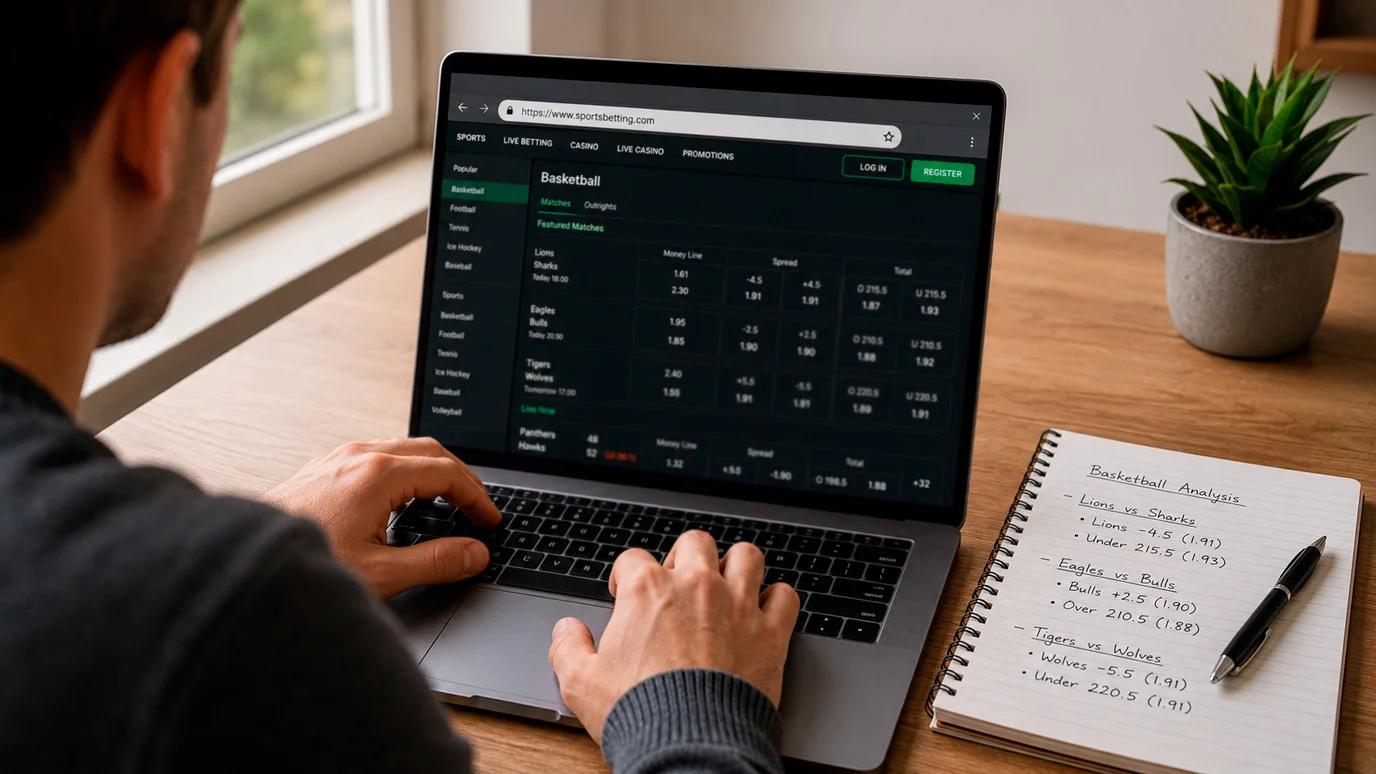
The share of the legal betting market in the UK has declined from 97% in 2019 to 92% in 2025, with illegal betting reaching an estimated GBP 16.6 billion. That erosion is partly driven by affordability measures that push some bettors toward unregulated alternatives — a trade-off regulators are actively wrestling with. Sticking to licensed operators means your funds are ring-fenced, your complaints have a formal resolution path, and you have access to every responsible gambling tool the law requires.
Financial Risk Assessments generate the most confusion among UK sports bettors. Helen Rhodes, Director of Major Policy Projects at the UKGC, noted that much recent commentary about financial risk assessments has been ill-informed or inaccurate. The reality: FRAs affect only 3% of the highest-staking customers, and 97% of those flagged clear automatically without providing any documentation. The remaining cases involve enhanced checks that may require proof of income, but these thresholds sit well above recreational staking levels.
Remote Gaming Duty doubled in 2025. The UK government raised the tax on online gambling operators from 21% to 40% in the Autumn Budget. That is a cost borne by the operator, not deducted from your winnings — but it has downstream effects. Higher tax burdens can compress the odds margins bookmakers offer, which means fractionally worse prices on basketball markets compared to pre-increase levels. As a bettor, this makes odds comparison between operators more valuable than ever.
Your rights as a UK bettor include access to the operator's complaint procedure, escalation to an Alternative Dispute Resolution provider, access to your betting history, and the right to close your account or self-exclude at any time. These are legal requirements under the Gambling Act, not optional features. For the full regulatory picture and how affordability checks interact with your basketball betting, the guide to evaluating basketball betting sites breaks down what to look for before you open an account.
Responsible Gambling Tools for Basketball Bettors
During Safer Gambling Week 2025, UK operators sent 10.95 million responsible gambling messages — a 75% increase over 2024. In that same period, 153,960 accounts set a total of 281,000 deposit limits, up 41% from the previous year. Grainne Hurst, CEO of the Betting and Gaming Council, described the figures as evidence of the industry's ongoing commitment to ensuring millions of people who enjoy a regular flutter do so safely and responsibly. Those are not just press-release numbers — they represent real tools available to you right now, at every UKGC-licensed bookmaker.
Basketball's betting calendar is relentless. The NBA regular season runs 82 games per team, with as many as 15 games on a single night. Add EuroLeague midweek fixtures, BBL weekends, and WNBA in the summer, and there is almost no day of the year without basketball to bet on. That constant availability — compounded by the late-night tip-off times for NBA games in the UK — makes session discipline a genuine challenge. The tools exist precisely for this environment.
Responsible gambling tools available at UKGC-licensed operators
- Deposit limits — daily, weekly or monthly caps on how much you can add to your account. Once set, increases require a cooling-off period before taking effect.
- Loss limits — separate from deposit limits, these cap how much you can lose within a specified period.
- Session time limits and reality checks — alerts that tell you how long you have been active and how much you have wagered during the session.
- Cooling-off periods — temporary breaks of 24 hours, 48 hours, one week or one month during which your account is inactive but not closed.
- Self-exclusion — voluntary exclusion from a single operator's platform for a minimum of six months.
- GAMSTOP — the national self-exclusion scheme that blocks your access to all UKGC-licensed online gambling sites simultaneously. Registration is free and covers a minimum of six months, with options for one year and five years.
Do
- Set a deposit limit before your first basketball bet — it takes 30 seconds and prevents impulsive decisions during a live NBA game at 2am from exceeding your budget.
- Use reality checks if you plan to bet in-play on late-night NBA games. A notification after 60 minutes of activity is a useful circuit breaker.
- Review your betting history monthly. Patterns — chasing losses, increasing stakes after bad runs — are easier to spot in retrospect.
Do not
- Chase losses by increasing your stake on the next game. Basketball offers so many nightly fixtures that the temptation is constant — and it is a trap.
- Bet on leagues or markets you do not understand just because they are available.
- Ignore the signs of gambling becoming a problem: betting more than you planned, feeling anxious when not betting, hiding your activity from people close to you.
If you or someone you know is experiencing difficulty with gambling, support is available through the National Gambling Helpline and through GamCare's online resources. These services are free, confidential, and staffed by trained advisers who understand the specific pressures of sports betting.
Betting Integrity: Why It Matters for Your Wagers
In October 2025, NBA Commissioner Adam Silver sat down at half-time of a nationally televised Celtics-Knicks game and said something that stopped me mid-analysis: "There's nothing more important to the league and its fans than the integrity of the competition. I had a pit in my stomach. It was very upsetting." He was responding to a series of insider betting indictments that had rocked the league — cases where confidential information about players and teams was exploited for wagering advantage. Joseph Nocella Jr., the US Attorney who brought the charges, described an insider sports betting conspiracy that exploited confidential information about NBA athletes and teams.
These were not abstract compliance failures. They were schemes that directly affected markets you and I bet on — player prop lines priced on public information while insiders traded on private knowledge about injury status, minutes restrictions and lineup decisions. Silver acknowledged the challenge openly, saying the league was learning as it went, working with betting companies and putting in place additional controls to prevent manipulation. He also pushed for more regulation, arguing for federal legislation rather than the current state-by-state approach in the US.
For UK bettors, the integrity picture has two layers. The first is the NBA's own enforcement, operating primarily in the US legal system. The second is the UKGC's framework, which requires licensed operators to report suspicious betting patterns and cooperate with sports governing bodies. The overlap is imperfect — the NBA's data-sharing agreements with UK regulators are not as comprehensive as its domestic arrangements — but the direction is toward greater integration.
Integrity enforcement affects your betting options directly. When insider cases emerge, bookmakers respond by restricting or removing specific markets — particularly niche player props that are most vulnerable to information asymmetry. If a prop market you regularly trade suddenly disappears or has its limits sharply reduced, an integrity investigation is often the reason. Understanding this dynamic prevents frustration and helps you anticipate which markets are most likely to be affected during periods of heightened scrutiny.
The practical implication is simple: bet on markets priced with robust data, at licensed operators who participate in integrity monitoring programmes. The NBA generates over $11.34 billion in annual revenue and has every financial incentive to protect the product. The UKGC has the enforcement apparatus to hold operators accountable. Between those two forces, the integrity infrastructure is stronger than it has ever been — but it is not infallible, and staying informed about ongoing cases helps you evaluate which markets carry hidden risk.
Pre-Bet Checklist: Steps Before Placing a Basketball Wager
I built this checklist after cataloguing the most common mistakes I saw in reader emails over four years. Every single one of these steps addresses a real situation where a bettor lost money or missed value because they skipped a basic piece of preparation. Mobile platforms dominate basketball betting — over 70% of all basketball wagers are now placed through mobile devices — which means speed and convenience are built into the process. That is usually a good thing. It becomes a problem when speed replaces preparation.
Before you place any basketball bet
- Check the injury report. NBA teams are required to submit injury reports by 5pm local time on game day. For evening tip-offs in the US, that means the report drops between 10pm and 1am UK time. A late scratch of a key player can swing a line by 3–5 points and dramatically alter prop market viability.
- Verify which market you are selecting. "Team A -4.5" on the match handicap is not the same as "Team A -4.5 first half." Confirm the market header before adding the selection to your slip.
- Confirm overtime rules for your specific market. If you are betting totals or player props, overtime is included. If you are betting a quarter or half market, it is not. If in doubt, check the bookmaker's basketball rules page.
- Compare odds across at least two bookmakers. Basketball lines are tighter than football lines at major UK operators, but half-point and margin differences still exist — and they compound over hundreds of bets.
- Set or review your deposit limit. If you have not set a deposit limit, do it now. If you have one, review whether it still reflects your intended budget.
- Check the game time. NBA games run approximately 2 hours 15 minutes. If you are betting in-play on a 1am tip-off, you are committing to being alert and making decisions until at least 3:15am. Decide in advance whether you will use cash out to exit early or stay for the full game.
Worked example: building a pre-match NBA bet
Suppose you want to bet on an NBA game tipping off at 12:30am UK time. The line is Team A -5.5 at odds of 1.91 and the total is set at 219.5.
Step 1 — Check the injury report released approximately two hours before tip-off. Team A's starting centre is listed as questionable with a knee issue, affecting both the handicap and the total.
Step 2 — Monitor the line. If the centre is ruled out, the handicap may move from -5.5 to -3.5 or -4. Waiting for the line movement gives you a better number.
Step 3 — Decide on market. The centre's absence hurts Team A's offence more than their defence. You opt for the under on totals at 219.5. Odds: 1.93.
Step 4 — Place the bet. GBP 20 stake at 1.93 = GBP 38.60 potential return (GBP 18.60 profit). Confirm the market says "including overtime" and submit.
Step 5 — Set a mental exit point. If the first half lands at 115+ combined points, you decide in advance to cash out if the live total projection exceeds 230 at half-time.
This process takes five minutes. It does not guarantee a winner — nothing does — but it eliminates the class of errors that come from betting impulsively on a market you have not fully evaluated. The structural knowledge from this guide gives you a framework that scales from your first NBA bet to your thousandth.
Frequently Asked Questions
Does overtime count in basketball betting?
For the three most popular basketball markets — moneyline, handicap and totals — overtime is included in settlement at all major UK bookmakers. Quarter-specific bets and half-time markets settle on regulation time only. Three-way moneyline markets (where a draw at the end of regulation is an option) also exclude overtime by definition. If you are ever unsure, the market header at your bookmaker will typically state "including overtime" or "regulation time only." When it does not, check the operator's basketball settlement rules before placing your bet.
What happens if a basketball game is abandoned?
If a basketball game is abandoned before the minimum game time threshold is reached — 43 minutes for the NBA, 35 minutes for most other leagues — all bets are typically voided and stakes returned. Markets where the outcome was already determined before the abandonment (such as first-quarter bets after three quarters have been completed) usually stand. Postponed games that are rescheduled within the bookmaker's specified window (commonly 24–48 hours) remain valid. Games moved to a different venue may or may not trigger void conditions depending on the operator's rules.
What does "push" mean in basketball betting?
A push occurs when the result lands exactly on the betting line. For example, if you bet Team A -6 and they win by exactly 6 points, the bet pushes. On a single bet, a push returns your stake — you neither win nor lose. In an accumulator, the pushed leg is removed and the remaining legs are recalculated at the reduced number of selections. Some bookmakers handle pushes differently in same-game parlays, so check the specific terms. Half-point lines (like -6.5) exist specifically to eliminate the possibility of a push.
Are basketball betting winnings taxed in the UK?
No. In the UK, all gambling winnings — including basketball betting profits — are tax-free for the bettor. The tax burden sits with the operator, not the customer. HMRC does not require you to declare gambling winnings on your tax return, regardless of the amount. The operator pays Remote Gaming Duty on their revenue, which was increased from 21% to 40% in the 2025 Autumn Budget. That cost may indirectly affect the odds you are offered, but you will never have tax deducted from a payout.
What leagues can I bet on for basketball in the UK?
UK bookmakers with UKGC licences offer markets on the NBA, EuroLeague, BBL (British Basketball League), WNBA, NCAA college basketball (including March Madness), FIBA international competitions, and various European domestic leagues including Spain's Liga ACB, Turkey's BSL and Greece's Basket League. The NBA carries by far the widest market selection — often 100+ markets per game — while smaller leagues may be limited to moneyline and handicap only. Market availability varies between operators, so check before assuming your bookmaker covers a specific competition.
How do player props work in basketball betting?
Player props are bets on individual statistical outcomes — points scored, rebounds, assists, three-pointers made, and combined stat lines. You bet on whether the player will go over or under a specified line. For the bet to stand, the player must take the court; if a player is a late scratch and never plays, the bet is voided at most bookmakers. Overtime statistics are included in player prop settlement. If a player records limited minutes but does enter the game, the bet stands and settles on whatever stats they accumulate, even if they score zero.
What is point spread (handicap) in basketball?
Point spread and handicap are two names for the same market — the terminology differs between US usage ("spread") and UK/European usage ("handicap"). The bookmaker assigns a virtual point advantage to the underdog and an equivalent disadvantage to the favourite. If the spread is -7.5 on the favourite, that team must win by 8 or more points for the bet to win. The underdog at +7.5 can lose by up to 7 points and the bet still pays out. Overtime is included. Whole-number spreads can push if the margin lands exactly on the line.
