
Best UK Basketball Betting Sites: Compare Markets and Odds
 Available in US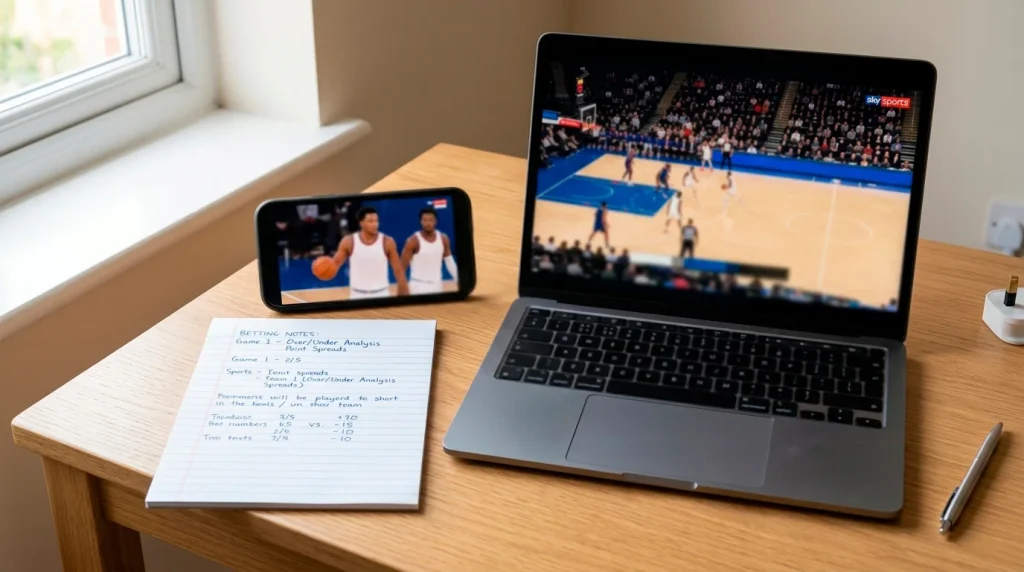
Every January, like clockwork, I get a wave of messages from readers asking the same question: “Which is the best basketball betting site?” My answer disappoints them every time because it is not a name — it is a checklist. The best site for you depends on what you bet on, how you bet, and what you value in the experience. A bettor who exclusively trades NBA player props has fundamentally different needs than someone who places pre-match accumulators across multiple leagues.
The UK’s online betting market generates 16.8 billion pounds in gross gambling yield annually, and the number of UKGC-licensed operators competing for that revenue means you have genuine choice. That choice, though, comes with a responsibility to evaluate rather than just pick the name you have seen advertised most often. The gap between a well-suited operator and a poorly chosen one shows up in your returns — through tighter odds, faster settlement, better live betting infrastructure, and fairer terms that do not punish you for winning.
This guide is not a ranking. I do not review individual bookmakers or recommend one over another. What I do is give you the criteria that matter for basketball betting specifically, so you can evaluate any operator yourself and make a decision based on substance rather than marketing. Think of it as a buying guide for a product where the wrong choice costs you money every time you use it.
UKGC Licensing: Guaranteeing Safe and Secure Betting Sites
I start every conversation about choosing a betting site with the same line: if the operator does not hold a UKGC licence, stop evaluating immediately. Nothing else matters. Not the odds, not the promotions, not the sleek app design. An unlicensed operator sits outside the regulatory framework that protects your deposits, guarantees fair settlement, and gives you recourse when things go wrong.
The scale of the illegal market in the UK is not trivial. The share of legal betting has declined from 97% in 2019 to approximately 92% in 2025, with unlicensed gambling reaching an estimated 16.6 billion pounds. The UKGC has responded aggressively — Tim Miller, the Commission’s Executive Director, revealed at the Ethical Gambling Forum in London that the UKGC issued 741 cease-and-desist notices in 2025-2026, and nearly 398,000 illegal URLs were referred to search engines for removal, of which roughly 267,000 were taken down. Gráinne Hurst, CEO of the Betting and Gaming Council, put the stakes plainly: “At a time when the illegal harmful black market poses a growing threat to player safety, it is vital customers remain in the regulated market, where robust safer gambling measures and protections are available.”
Verifying a UKGC licence takes thirty seconds. Every licensed operator must display their licence number in the footer of their website and within the “About” or “Legal” section of their app. You can cross-reference this number against the UKGC’s public register to confirm it is valid and current. The register also shows any conditions or sanctions attached to the licence, which gives you insight into the operator’s compliance history. A licence with multiple conditions or recent enforcement actions is a signal worth paying attention to.
UKGC licensing guarantees several concrete protections: your funds must be held in segregated accounts (or the operator must disclose the level of fund protection they offer), settlement disputes can be escalated to an independent Alternative Dispute Resolution provider, and the operator must offer responsible gambling tools including deposit limits, self-exclusion, and reality checks. These protections are not voluntary add-ons — they are licence conditions that the operator must meet to remain authorised. Betting with an unlicensed operator means none of these protections apply to you.
Market Depth: How Many Basketball Markets Should a Site Offer?
The number of markets an operator offers on a single NBA game tells you more about their commitment to basketball than any marketing claim. A basic operator might list moneyline, handicap, and total points. A serious basketball bookmaker will offer those plus alternative lines, quarter and half markets, player props across multiple statistical categories, same-game parlays, team totals, race-to-X-points, and various combination markets. The difference between 20 markets per game and 200 is the difference between being able to express a specific opinion and being forced to compromise.
The NBA generates approximately 60% of global basketball betting revenue, and as a result it receives the most comprehensive market coverage at UK bookmakers. If an operator offers deep NBA markets but only moneyline and totals for EuroLeague, that tells you their basketball trading desk is NBA-focused. If you plan to bet on European competitions or the BBL, you need an operator whose market depth extends beyond the NBA.
Player props deserve specific attention when evaluating market depth. The range of player prop markets available varies significantly between operators. Some offer props on points, rebounds, and assists for every starter. Others extend to steals, blocks, three-pointers made, turnovers, and combined statistical categories. If player props are central to your betting approach — and they are for an increasing number of basketball bettors — a limited prop menu will constrain your options and force you into less favourable markets.
One practical test I use: pick a midweek regular-season NBA game between mid-table teams (not a marquee matchup) and count the available markets at each operator you are evaluating. Marquee games attract deep coverage everywhere; it is the mid-tier fixtures that reveal whether an operator genuinely invests in basketball coverage or merely rides the high-profile schedule.
Live Betting Quality and Speed
Live betting on basketball is not a feature — it is a different product entirely. In mature European markets, in-play bets account for 52% to 60% of total betting handle, and basketball’s fast scoring pace makes it one of the most actively traded live sports. The quality of the live betting experience varies wildly between operators, and this is an area where a poor platform costs you money through missed opportunities, delayed odds updates, and clunky interfaces that cannot keep pace with the game.
Speed is the primary differentiator. Basketball is a sport where the scoring state changes every 20 to 30 seconds on average. A possession ends, the score updates, and the odds should adjust within seconds. Operators with strong in-play infrastructure — typically those using Sportradar’s premium live data feeds — achieve near-instant odds adjustments. Operators with weaker infrastructure lag, sometimes by 10 to 15 seconds, which creates two problems: you cannot place bets at the price you see because it has already changed, and the odds displayed are stale, meaning you are evaluating positions based on outdated information.
Suspension frequency is the second metric to watch. During live basketball betting, markets are temporarily suspended whenever the ball is dead — during timeouts, at the end of quarters, during free throws, and sometimes during fast breaks where the outcome is near-certain. Every suspension is a window where you cannot bet. Operators that suspend broadly and reopen slowly effectively reduce the amount of time their live markets are available. Operators with more sophisticated risk models suspend less frequently and for shorter durations, giving you more opportunities to trade.
The rise of micro-betting — next-possession and next-basket markets that settle within seconds — has added another dimension. Micro-betting grew by 214% year on year in 2024 and now accounts for 38% of all in-play bets on major platforms. Not every UK operator offers micro-betting markets for basketball, and those that do vary in scope and speed. If real-time, rapid-fire betting appeals to you, this is a feature worth evaluating before you commit to an operator.
Comparing Odds Value Across Bookmakers
Here is a thought experiment I run with every new reader who tells me they have “found their bookmaker.” Pick any upcoming NBA game. Pull up the moneyline on three different operators. Now compare the prices. On a typical regular-season game, the difference between the best and worst moneyline price among major UK bookmakers is usually 3 to 6 pence per pound staked. That sounds trivial — until you multiply it across hundreds of bets per season. A bettor placing 20 pounds on 200 NBA bets across a season who consistently takes the worst available price instead of the best is giving up somewhere between 120 and 240 pounds in value over that period. Not through bad analysis, not through poor discipline, but simply by not shopping.
Odds comparison is less about individual bets and more about the margin — the overround — that each operator builds into their prices. The overround is the bookmaker’s theoretical profit baked into the odds. A perfectly fair market on a two-outcome event would have an overround of exactly 100%. In practice, UK bookmakers price NBA moneylines with overrounds ranging from roughly 103% to 108%, depending on the operator and the specific market. The tighter the overround, the closer the odds are to the true probability, and the better value you are getting.
Player prop markets tend to carry wider margins than match result markets. This makes intuitive sense: props are harder for bookmakers to price precisely, so they build in more cushion. The overround on an NBA player points prop can reach 110% or higher at some operators, while at others it sits closer to 105%. If player props form a significant part of your betting activity, these margin differences compound aggressively over time.
The basketball betting market — valued at $8.7 billion globally in 2024 and projected to reach $18.4 billion by 2033 — is large enough that operators compete fiercely on pricing for headline markets. Where they differ most is on secondary markets: alternative lines, team totals, quarter props, and same-game combinations. These are the markets where the overround widens, where comparison shopping produces the biggest gains, and where most bettors never bother to look because the headline moneyline price was acceptable. Do not settle for acceptable when better is a tab away.
Mobile App vs Desktop: What Matters for Basketball
I placed my first basketball bet on a desktop browser in 2009. Today, more than 70% of basketball betting volume comes through mobile devices, and I would estimate my own split is closer to 90% mobile. The shift is not just about convenience — it reflects how basketball betting actually works in practice. NBA games tip off between 11 PM and 3:30 AM UK time, and very few people are sitting at a desk at that hour. You are on the sofa, in bed, or — if you are committed — watching on a second screen while the app sits in your hand.
A good basketball betting app needs three things above all else. First, the live betting interface must load quickly and update in real time without manual refreshing. Basketball’s pace means odds change every possession, and an app that requires you to pull-to-refresh or navigate through multiple screens to find the current live markets for a game you are watching is not fit for purpose. The bet slip should be accessible in one tap from any live market, and the confirmation process should be as short as the operator’s regulatory obligations allow.
Second, the app should offer full market depth — not a stripped-down version of what is available on desktop. Some operators historically offered fewer markets in their mobile apps than on their websites, particularly for player props and alternative lines. This gap has narrowed significantly in recent years, but it has not closed entirely. Before committing to an operator, open the same NBA game on both their app and their desktop site and compare the available markets. If the app is missing markets you use regularly, that is a meaningful limitation.
Third, push notifications should be customisable and useful. The ability to set alerts for line movements on games you have bet on, score updates, and market availability changes is genuinely valuable for basketball bettors who are not watching every minute of every game. Generic promotional notifications are noise; tailored alerts on the markets and games you care about are signal. The best apps let you distinguish between the two.
Desktop still has advantages for research-heavy pre-match betting. Screen real estate matters when you are comparing lines across markets, reviewing team statistics, and building complex same-game parlays. If your approach is analytical and deliberate, desktop is the better environment for constructing your bets. Once the bet is placed, though, mobile is where you manage it — and the strategic framework behind your selections matters more than whether you placed the bet on a phone or a laptop.
Your Evaluation Checklist: Choosing a Betting Site
After years of fielding the “which bookmaker should I use” question, I developed a systematic evaluation approach that I now walk every serious basketball bettor through. The process takes about an hour, and it replaces gut feeling with evidence.
Start by confirming the operator holds a valid UKGC licence — we covered why in detail earlier. Then open a midweek NBA regular-season game and count the total number of pre-match markets available. Anything below 80 markets suggests a limited basketball offering. Above 150 signals a serious commitment. Check whether player props cover all five starters across at least points, rebounds, and assists. Check whether alternative handicap and total lines are available in half-point increments. Check whether quarter and half markets exist alongside full-game options.
Next, evaluate the live betting experience during an actual game. This step requires timing — you need a live NBA game to assess properly. Open the in-play section and observe how frequently markets suspend, how quickly odds update after scoring plays, and whether the micro-betting markets (next basket, next possession outcome) are available. Time how long a market stays suspended during a routine timeout. If it exceeds 45 seconds consistently, the operator’s live infrastructure is below average.
Odds value requires comparison. Pick three games on the same evening and record the moneyline, spread, and total at the operator you are evaluating alongside two competitors. Calculate the overround for each — for a two-way market, convert both decimal odds to implied probabilities and add them. An overround below 105% on NBA moneylines is competitive. Above 107% and you are paying a premium.
Test the cash-out function on a small stake bet. Place a low-value pre-match bet, wait until the game is in-play, and attempt to cash out. Note whether the cash-out is offered on all market types, whether partial cash-out is available, and how quickly the cash-out processes. Some operators are generous with cash-out availability pre-match but restrict it heavily during live play — this is worth knowing before you rely on the feature.
Finally, check the withdrawal process before you deposit significant funds. Deposit a small amount, place and settle a bet, and request a withdrawal. Note how long it takes to process, whether any verification steps create delays, and whether the withdrawal method mirrors your deposit method. An operator that makes deposits instant but withdrawals slow is optimising for their cash flow, not your experience.
Red Flags: Signs a Basketball Betting Site Is Not Worth Using
Not every red flag announces itself with a siren. The worst ones are quiet — buried in terms and conditions, hidden behind interface choices, or only visible after you have already deposited. I have compiled these from years of reader complaints, personal experience, and conversations with other professional bettors, and every single one has cost someone real money.
Aggressive account restrictions on winning bettors are the most common grievance I hear. Some operators limit stakes for customers who show consistent profitability, reducing maximum bet amounts to trivially small sums or restricting access to certain markets. This practice is legal and widespread, but the speed and severity with which an operator limits accounts varies enormously. An operator that restricts your account after a handful of winning weeks is signalling that they view informed bettors as a problem rather than a customer segment. The approximately 290 million online bets placed per month in the UK generate enormous data, and operators that use that data to penalise skill rather than improve their pricing deserve scrutiny.
Poor transparency around settlement rules is another warning sign. If you cannot find the basketball-specific settlement terms within two clicks from the main sports page, the operator is not making it easy for you to understand what you are agreeing to. The full breakdown of how basketball bets settle covers the technical details, but the principle is simple: an operator that buries its rules is an operator that benefits from your confusion.
Watch for operators that heavily promote accumulators and complex multi-leg products while burying single-bet options. Accumulators carry significantly higher margins for the bookmaker because the overround compounds with each leg. An operator whose homepage defaults to accumulator builders, whose promotions are exclusively tied to four-fold-or-more bets, and whose interface makes single bets less accessible than multiples is steering you toward products that favour them, not you.
Slow or inconsistent settlement should raise immediate concerns. NBA game results are official within minutes of the final buzzer, and pre-match bets should settle within the hour. Player props sometimes take slightly longer as statistical providers verify final numbers, but any delay beyond a few hours is abnormal. If your bets regularly remain unsettled until the following morning, the operator’s back-end infrastructure is either understaffed or poorly automated — and neither possibility reflects well on their operation.
Finally, be wary of operators that make responsible gambling tools difficult to access. Deposit limits, session reminders, and self-exclusion options should be available from your account settings in one or two taps. Helen Rhodes, the UKGC’s Director of Major Policy Projects, has stressed the importance of robust player protections within the licensed market. An operator that buries these tools deep in nested menus or requires you to contact customer support to set a deposit limit is failing a basic regulatory expectation — and if they cut corners on player protection, they are cutting corners elsewhere too.
Frequently Asked Questions
Recommend
Prepared by the CourtEdge editorial staff.
