
UK Basketball Bankroll Management: Protect Betting Funds
 Available in US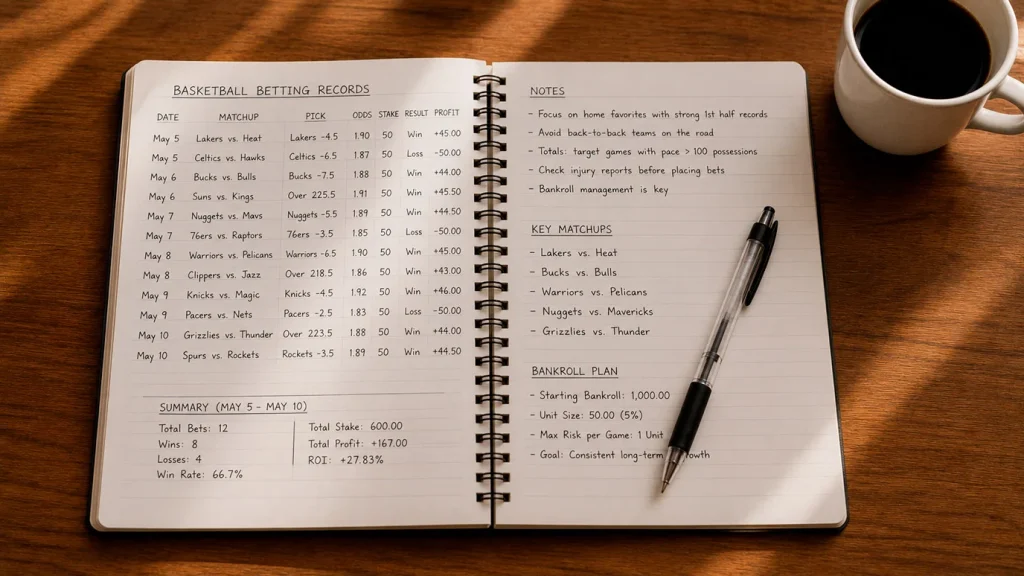
I blew through an entire betting bankroll in my second season of serious basketball wagering. Not because my analysis was wrong — my win rate that season was 53% on handicaps, which is profitable long-term — but because I staked too aggressively after a hot streak, chased losses after a cold spell, and had no system for deciding how much to risk per bet. The irony of losing money while picking winners taught me that bankroll management is not a secondary skill. It is the primary one.
Bankroll Setup: Establishing Secure Staking Plans
Your bankroll is a dedicated pool of money separated entirely from your living expenses. This is not a guideline — it is a hard rule. The moment you start dipping into rent money or savings to fund basketball bets, you have crossed from structured betting into gambling without guardrails.
The amount depends on your circumstances, but the principle is universal: it should be money you can lose entirely without affecting your life. For most recreational bettors in the UK, that means a bankroll of 200 to 1,000 pounds. For more serious bettors, the figure scales with disposable income and commitment level. The number itself matters less than your commitment to treating it as a fixed resource with strict allocation rules.
Once you have set your bankroll, divide it into units. A standard unit size is 1 to 2% of your total bankroll. If your bankroll is 500 pounds, one unit is 5 to 10 pounds. Every bet you place should be expressed in units rather than pound amounts — this forces discipline and prevents emotional stake sizing. A one-unit bet is your standard wager. A two-unit bet signals above-average confidence. Anything above three units should be exceptionally rare, reserved for the strongest edges you identify all season.
Flat Staking Versus Proportional Staking
There are two main approaches, and I have used both. Flat staking means every bet is the same size — one unit, regardless of your confidence level or the odds. Proportional staking adjusts the stake based on edge strength or odds value.
Flat staking is simpler and more forgiving of errors. When every bet is the same size, a bad run costs you a predictable number of units and the recovery path is clear. You do not need to assess your own confidence accurately — you just need to decide whether a bet meets your minimum threshold for value. For most basketball bettors, especially those in their first few seasons, flat staking at one unit per bet is the right approach. It removes one decision variable from a process that already has plenty of complexity.
Proportional staking — sometimes called the Kelly Criterion in its mathematical form — sizes each bet relative to your perceived edge. If you believe a bet has a large edge, you stake more. If the edge is marginal, you stake less. The theoretical advantage is maximising long-term bankroll growth. The practical disadvantage is that it requires you to accurately assess your edge on every single bet, and most bettors overestimate their edge consistently. An overestimated edge leads to oversized stakes, which leads to faster ruin during the inevitable losing streaks.
If you do use proportional staking, cap your maximum at 3% of your current bankroll per bet, and apply a half-Kelly or quarter-Kelly fraction rather than the full calculated stake. This buffer protects against the estimation errors that even experienced bettors make.
Surviving Losing Streaks in a Long Season
The NBA regular season is 82 games per team, running from October through April, with the playoffs extending into June. That is eight months of nightly betting opportunities. Over that duration, losing streaks of 8 to 12 bets are statistically normal for a bettor with a 55% win rate. I cannot stress this enough: a 10-bet losing streak does not mean your analysis has failed. It means variance is doing exactly what probability theory predicts.
The emotional response to a losing streak is the single biggest threat to your bankroll. The urge to increase stakes to “make it back quickly” is powerful and universally felt. Resist it. Doubling your unit size after a losing streak means you are taking the most risk at the moment your bankroll is smallest and your confidence is most fragile — the worst possible combination.
A practical technique I use: after any losing streak of 5 or more bets, I take one full day off from betting. Not from analysis — I still watch games and track lines — but from placing actual wagers. The break disrupts the emotional cycle and forces a reset. When I return, I place one-unit bets only, regardless of how much I need to “recover.” The bankroll recovers through consistent edge exploitation over time, not through aggressive chase betting.
Tracking and Reviewing Your Results
If you are not tracking your basketball bets in a spreadsheet, you are flying blind. Every bet should be logged with the date, the game, the market (handicap, total, prop), the odds, the stake, and the result. Over a season, this data reveals patterns that no amount of intuition can replicate.
The UK has approximately 290 million online bets placed per month across all sports, and the vast majority of those bettors keep no records. That is a strategic disadvantage they are volunteering for. A simple spreadsheet that calculates your return on investment by market type, by league, by day of the week, and by confidence level transforms your betting from a series of individual decisions into a quantifiable system you can audit and improve.
Review your results monthly, not daily. Daily reviews amplify noise and create false narratives — “I always lose on Tuesday” based on three Tuesday bets is not a pattern. Monthly reviews over a full NBA season give you enough data to identify genuine strengths and weaknesses. If your handicap betting shows a 6% ROI but your player props are at -4%, the allocation decision is clear: shift volume toward handicaps and reduce or eliminate props until you improve your process for that market.
The tracking habit also forces honesty. It is easy to remember your winners and forget your losers when you are not writing everything down. The spreadsheet does not lie. If your season record shows a 48% win rate on handicaps at average odds of 1.90, you are losing money — and the sooner you confront that reality, the sooner you can adjust. For more on how different basketball markets work and which ones suit your strengths, explore the full markets guide.
Articles
Written by the editors at CourtEdge.
