
UK Basketball Handicap Betting: Maximizing Point Spreads
 Available in US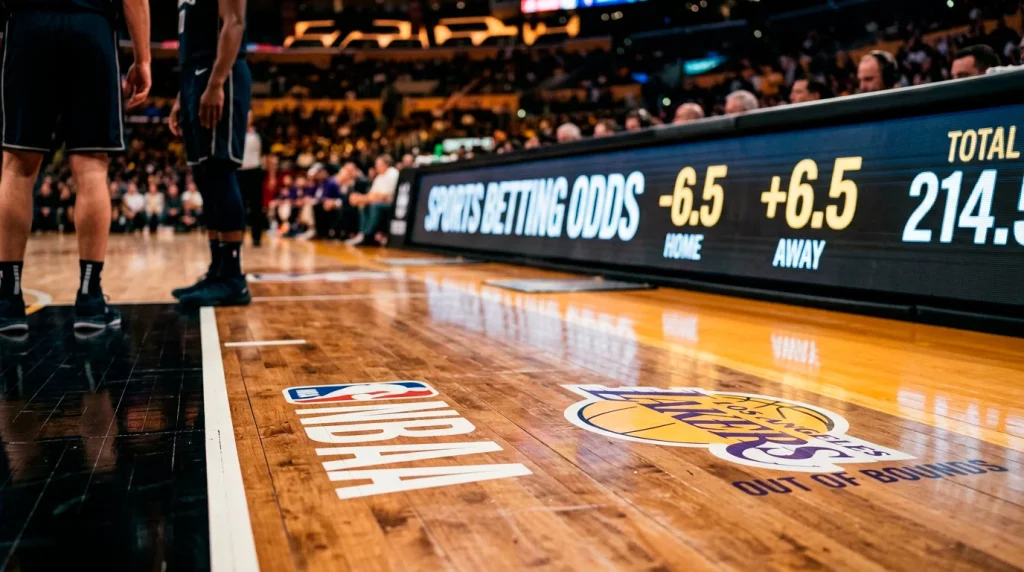
The first time I placed a basketball handicap bet, I picked the Golden State Warriors at -7.5 and watched them win by exactly seven points. That half-point haunted me for days. Handicap betting — known as point spread or spread betting in the US — is the single most popular market in basketball wagering, and understanding how it works is the difference between betting with structure and betting on gut feeling. The global basketball betting market reached 8.7 billion dollars in 2024, and handicap markets account for the largest share of that volume by a significant margin.
Basketball Handicap Lines: Unlocking True Market Value
I talk to a lot of football bettors who are moving into basketball, and the handicap concept clicks fastest when I frame it this way: the bookmaker is giving one team a head start and the other a deficit before the game even begins. Your bet wins or loses based on the final score after that adjustment is applied.
If the Boston Celtics are -6.5 against the Charlotte Hornets, the bookmaker is saying the Celtics need to win by 7 or more points for a bet on them to pay out. The Hornets at +6.5 means Charlotte can lose by up to 6 points and your bet still wins. The handicap number creates a new dimension of analysis beyond simply picking the winner — it forces you to assess not just who wins but by how much.
Basketball handicaps are almost always set at half-point increments — 3.5, 6.5, 10.5 — specifically to eliminate the possibility of a push, where the margin lands exactly on the line and the bet is returned as a void. Some operators do offer whole-number handicaps with push rules, but the half-point standard dominates UK sportsbooks for basketball. If you want to understand how pushes work when they do occur, the push rules guide covers the mechanics in detail.
Reading Handicap Lines at UK Bookmakers
Last season I tracked how the same NBA game was priced across five different UK operators on the same evening. The handicap line varied by up to 2.5 points between them — a massive discrepancy in a market where games are regularly decided by single-digit margins.
At UK bookmakers, basketball handicaps are displayed as a positive or negative number next to each team. The negative number indicates the favourite — they must overcome that deficit. The positive number indicates the underdog — they receive that head start. The odds attached to each side are typically close to even, usually between 1.85 and 1.95 in decimal format, reflecting the bookmaker’s margin on a roughly 50/50 proposition.
The handicap number itself is the bookmaker’s estimate of the expected winning margin. A line of -8.5 implies the favourite is expected to win by approximately 8 to 9 points. This estimate is built from power ratings, recent form, home-court advantage, injury reports, and back-to-back scheduling — the same factors you should be evaluating independently before deciding whether the bookmaker’s line is accurate.
One detail that catches new basketball bettors: the handicap applies to the final score including overtime. If a game goes to OT and the favourite wins by 12 after regulation was tied, that 12-point margin counts. The handicap is settled on the full-time result, not the regulation result, unless you are specifically betting a regulation-time handicap market where available.
Why Half Points Matter More Than You Think
In football, the difference between a 1-0 win and a 2-0 win feels significant. In basketball, the difference between a 6-point win and a 7-point win can feel almost random — one extra free throw, one meaningless late basket. But at the handicap window, that single point is the entire bet.
NBA games cluster around certain final margins more than others. Margins of 3, 5, 7, and 10 points occur more frequently because of the scoring system’s structure (three-point shots, two-point shots, free throws) and because of game-flow dynamics like intentional fouling in the final minutes. A team trailing by 8 with 30 seconds left will foul, the opponent hits one of two free throws, and the game ends with a 9-point margin instead of 8. These end-of-game mechanics create “key numbers” that savvy handicap bettors monitor closely.
The practical takeaway: when you see a handicap line sitting on or near a key number — particularly -7 or -7.5 in the NBA — the half-point matters enormously. Games landing on a 7-point margin happen more often than the slim difference between 7 and 7.5 would suggest. Paying attention to these key numbers and shopping across operators for the best line is one of the most consistent edges available to basketball handicap bettors.
Handicap Strategy for Different Game Types
Not every basketball game deserves the same handicap approach. I have found through years of tracking that certain game contexts produce more predictable margins than others, and adjusting your strategy accordingly is where long-term profit hides.
Regular-season games between teams with large talent gaps tend to see favourites cover at higher rates when the spread is between 5 and 9 points. Spreads above 10 get riskier because blowouts trigger bench rotations — the favourite’s starters sit out the fourth quarter, and the final margin compresses. I lost count of how many -14.5 bets I watched evaporate because the favourite’s coach pulled his starters with six minutes left and the opponent’s bench unit cut the lead to 11.
Playoff games are a different animal entirely. The intensity increases, rotations shorten, and the better team tends to assert control more consistently. Historically, home teams in the NBA playoffs cover the spread at a slightly higher rate than in the regular season, partly because crowd energy and referee tendencies tilt fractionally in their favour. But the margins are tighter — playoff handicaps tend to be smaller than regular-season handicaps for the same matchup because the bookmaker expects the underdog to compete harder.
Back-to-back scheduling creates another strategic layer. Teams playing the second game of a back-to-back, especially on the road, underperform relative to their standard power rating. The fatigue effect is measurable: approximately 0.5 to 1.5 points of additional underperformance depending on travel distance. If the bookmaker has not fully priced in the fatigue factor, the opponent’s handicap becomes more attractive.
Combining Handicaps in Accumulators
Basketball handicaps are the most common legs in multi-bet accumulators, and the math behind combining them is worth understanding before you stack four or five spreads into one slip. About 10% of UK adults bet online, and the ones who bet basketball accumulators disproportionately favour handicap legs because the near-even odds produce combined payouts that feel achievable rather than lottery-like.
A four-leg handicap accumulator at average odds of 1.90 per leg returns approximately 13.03 for a 1-unit stake. That looks appealing until you run the probability: at a true 50% hit rate per leg, you win 6.25% of the time. The bookmaker’s margin on each leg further reduces your expected value, making the true win rate closer to 5.5%.
My approach to handicap accumulators is to limit them to two or three legs and focus on games where I have the strongest conviction about the margin. A two-leg parlay at 1.90 per side returns 3.61 — a reasonable payout for a bet that hits roughly one in four times. Adding a third leg pushes the return to 6.86 but drops the hit rate to roughly one in eight. Beyond three legs, the mathematics work against you faster than the payout grows.
One more point on accumulators: if one leg of your handicap parlay voids — due to an abandoned game or a line error — the treatment depends on your operator. Most UK bookmakers remove the voided leg and recalculate at reduced odds, but the specifics vary and are worth checking before you build your slip.
Articles
Published by the CourtEdge team.
