
UK FIBA Basketball Betting: Top International Markets
 Available in US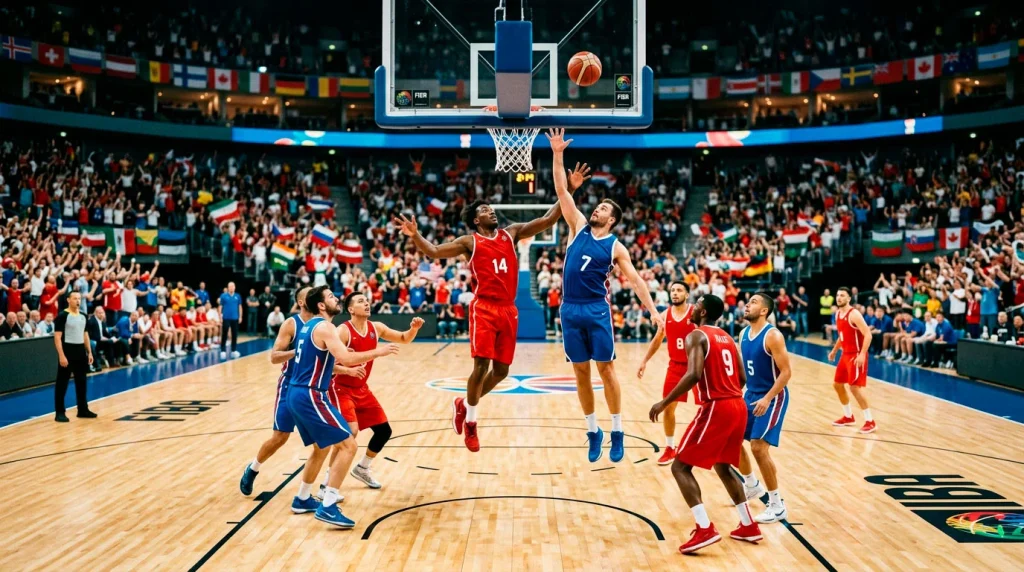
The 2023 FIBA World Cup threw up one of the strangest betting results I have ever seen: Germany — a team most casual fans could not name five players from — beat Serbia in the final and rewarded anyone who backed them pre-tournament at 21.00. International basketball is a different planet from the NBA, and the bettors who understand those differences find markets that are far less efficient than domestic league offerings. With basketball accounting for 14.2 percent of online betting revenue globally, FIBA tournaments represent a concentrated window of opportunity every summer.
FIBA Tournaments: Securing Value in International Odds
I watched the 2019 FIBA World Cup in China and was struck by how many UK bettors were confused by the format. They expected a straightforward knockout bracket and instead found a complex group-to-elimination structure that directly affects how you price each game. Understanding the format is not optional — it changes which bets make sense at each stage.
The FIBA Basketball World Cup, held every four years, uses a 32-team format. Teams are drawn into eight groups of four, play a round-robin within their group, and the top two from each group advance. The second round places the qualifiers into four groups of four for another round-robin, carrying over results from the first round against the other qualifying team. The top two from each second-round group then enter a single-elimination quarter-final-to-final bracket.
This two-phase group structure has direct betting implications. In the second round, teams carry over their result from the first round against the other team that qualified from their original group. If Team A beat Team B by 15 points in the first round and both qualify, Team A enters the second-round group with a carried-over win. This means the first-round matchup between two teams expected to qualify is more important than the others, and it is often underpriced by the market because casual bettors treat all group games equally.
EuroBasket, the European championship held every four years (with the most recent in 2022), uses a similar group-then-knockout format but with 24 teams. The FIBA AmeriCup, AfroBasket, and Asia Cup follow their own structures. Each tournament offers betting markets at UK bookmakers, though depth varies significantly — NBA bettors will find EuroBasket and the World Cup well-covered, while smaller continental tournaments may only have basic match winner and handicap markets.
Key Differences Between FIBA and NBA Rules
A friend who bet heavily on the NBA tried his hand at the 2023 World Cup without adjusting for the rule differences. He backed overs all tournament and lost most of them. FIBA basketball produces lower scores than the NBA, and the rules are a major reason why.
FIBA games are 40 minutes long — four 10-minute quarters — compared to the NBA’s 48 minutes. That alone reduces scoring by roughly 15-20 percent, but the effect is compounded by pace differences. The FIBA shot clock is 24 seconds (matching the NBA), but international teams generally play at a slower tempo with more structured half-court offences. The three-point line is 6.75 metres in FIBA compared to 7.24 metres in the NBA, which changes shooting distribution and spacing.
The lane is shaped differently — FIBA uses a rectangular key rather than the NBA’s trapezoidal one — and goaltending rules differ. In FIBA play, once the ball has touched the rim, any player can tip it in or swat it away, which creates different dynamics around offensive rebounds and putbacks. These subtle rule differences affect game flow, scoring patterns, and ultimately the totals and handicap markets.
Overtime in FIBA is a single five-minute period, and if the game is still tied, additional five-minute periods follow. For betting purposes, overtime rules at UK bookmakers for FIBA games typically mirror NBA settlement — the final score including overtime determines the result. But always verify with your specific operator, as FIBA tournament rules are less standardised across bookmakers than NBA settlement.
Pricing FIBA Games: What the Market Gets Wrong
During the 2023 World Cup, I tracked the closing lines against actual results for every game in the knockout stage. The average absolute error on the handicap was 8.3 points — nearly double what you see in a typical NBA regular season week. That gap between pricing accuracy and actual outcomes is where FIBA betting edges live.
International basketball markets are less efficient than NBA markets for several measurable reasons. The betting volume is lower, which means fewer sharp bettors are involved in price discovery. The data infrastructure is thinner — there is no equivalent of the NBA’s tracking cameras and real-time advanced statistics for most FIBA competitions. And the roster composition changes between tournaments, making historical team performance a weaker predictor than it is for club teams that play together all season.
National team chemistry is the hardest factor to price. A squad of NBA-calibre players who have three weeks of training camp together can be less cohesive than a team of EuroLeague professionals who have played together in FIBA windows for years. The United States has historically dominated international basketball but has also lost games — and tournaments — when the roster assembled for a particular event lacked familiarity and defensive cohesion.
Home-court advantage in FIBA tournaments is more volatile than in domestic leagues. When a host nation plays, the crowd effect can be enormous in early rounds — particularly in countries where basketball is the primary sport. But that advantage fades in later rounds against elite opponents who are accustomed to hostile environments. Pricing the host nation’s group-stage games requires accounting for a larger home-court bump than you would apply to a neutral-venue knockout game.
Betting on FIBA Windows and Qualifiers
Most UK bettors ignore FIBA qualifying windows entirely, which is understandable — they are played during the NBA and EuroLeague seasons, the rosters are depleted, and the games feel meaningless. But from a betting perspective, qualifier windows are some of the most exploitable events on the basketball calendar.
FIBA windows are two-week breaks in the international calendar when national teams play World Cup or continental championship qualifiers. NBA players are generally unavailable (their contracts take precedence), so national teams field rosters built from European and other domestic leagues. This creates massive roster instability — a team might field a completely different lineup in consecutive windows.
The betting markets for these games are set using limited data and low confidence. Bookmaker models struggle with roster turnover because there is no stable baseline to price from. A team that won its last qualifier by 20 might have had three EuroLeague starters available; this time, those players are injured or their clubs refused to release them. The team name is the same, but the quality is completely different.
If you follow European basketball closely enough to track which players are called up for each window, you have a genuine informational edge over the market. This is the kind of niche knowledge that rewards specialists — the 10 percent of UK adults who bet online are mostly focused on football and horse racing, leaving basketball qualifier markets with thin liquidity and soft lines.
Summer Basketball Betting Calendar for UK Bettors
When the NBA season ends in June, most basketball bettors in the UK go dormant until October. That is a mistake. The international basketball calendar fills the summer with competitions that offer both entertainment and genuine betting value — if you know where to look.
The FIBA World Cup (next edition in 2027) and the Olympic basketball tournament (next in 2028 in Los Angeles) are the marquee events, attracting full media coverage and deep betting markets. EuroBasket alternates years with the World Cup, giving European basketball bettors a major tournament almost every other summer.
Smaller but valuable tournaments include the FIBA Basketball Champions League (the secondary European club competition, running through the spring), the NBA Summer League in July (available at some UK bookmakers with limited markets), and various national team friendlies in the build-up to major tournaments.
The Summer League deserves a specific mention. It features NBA rookies and fringe roster players competing in Las Vegas, and the betting markets are extraordinarily volatile. The rosters change from game to game, the players are unfamiliar to the market, and the coaching strategies are experimental. If you watch the games and follow the box scores, you can build an edge quickly because the market has almost no stable information to price from. It is the closest thing to a pure information market in basketball betting, and it rewards attention disproportionately. Much of what applies to EuroLeague betting principles — different rules, thinner markets, niche knowledge advantages — applies even more strongly to FIBA competitions.
Articles
Written by the editors at CourtEdge.
