
UK Basketball Quarter Betting: Targeting Rapid Period Payouts
 Available in US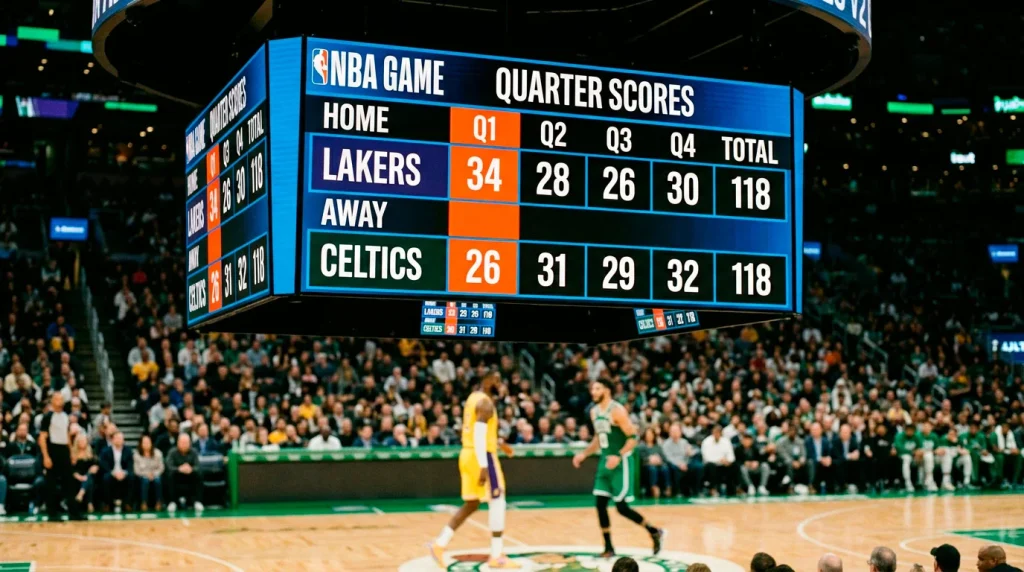
The first time I bet a first-quarter handicap, I won in eight minutes. The favourite’s starting lineup scored 18 unanswered points and the quarter ended with a 14-point margin that covered my line before the bench players even checked in. That speed and decisiveness is what makes quarter betting different from full-game markets — you are betting on short bursts of basketball where starter quality, opening tactics, and momentum swings play an outsized role.
Quarter Markets: Securing Early Returns in Basketball Bets
Quarter betting breaks an NBA game into four distinct 12-minute periods, each treated as a separate betting event with its own handicap, total, and moneyline markets. The settlement is based solely on the points scored within that specific quarter — not the cumulative score, not the full-game result. If you bet the first-quarter over at 55.5, only the points scored from the opening tip to the first-quarter buzzer count.
UK bookmakers typically offer all three market types — moneyline, handicap, and total — for the first quarter and for each subsequent quarter. First-quarter markets are the most liquid and receive the widest coverage, with pre-game availability at virtually every major operator. Second, third, and fourth-quarter markets are often available pre-game at larger bookmakers but may appear only as live betting options at smaller operators once the preceding quarter has ended.
An important structural point: quarter markets exclude overtime entirely. If a game goes to overtime, the fourth-quarter market is settled based on the scores at the end of the fourth quarter’s 12 minutes. The overtime period is a separate entity that does not affect any period-specific market. This differs from full-game markets, which include overtime in the settlement — a distinction that matters when the game is close heading into the final minutes.
First-Quarter Betting: Where the Edges Are
First-quarter betting is my favourite niche within basketball markets because the opening 12 minutes are the most predictable period of the game. Starters play the majority of first-quarter minutes, coaching strategies are at their most scripted, and the sample of teams’ first-quarter performance across a season is large enough to identify genuine tendencies.
Some NBA teams are consistently strong starters. They run set plays effectively, defend with intensity out of the gate, and build leads before the rotation deepens. Other teams are notoriously slow starters — they rely on bench-unit runs in the second quarter to compensate for sluggish openings. These tendencies are measurable and persistent across months of data. A team that has won the first quarter in 60% of their games over a 40-game sample is telling you something real about their preparation and opening-unit quality.
First-quarter totals tend to be lower than other quarters because teams are still finding their rhythm. Average first-quarter scoring across the NBA typically runs 1 to 3 points below the per-quarter average for the game total. If the full-game total is set at 224, the implied per-quarter average is 56 — but the first quarter regularly comes in at 53 to 55 because of early-game defensive intensity and the time it takes for shooting percentages to normalise.
The handicap line for the first quarter is roughly one-quarter of the full-game spread, adjusted for each team’s first-quarter tendencies. If the full-game spread is -8.5, the first-quarter spread might be -2.5 or -3.5 depending on whether the favourite is a notably fast or slow starter. The gap between the proportional spread and the actual first-quarter spread is where the value lives.
Third-Quarter Betting: The Adjustment Period
If the first quarter is about preparation, the third quarter is about adaptation. Half-time gives coaches 15 minutes to make tactical adjustments, review film, and redesign their approach to exploiting the opponent’s weaknesses. The third quarter is where those adjustments manifest, and the results are often dramatic.
Certain teams and coaches are renowned for dominant third quarters. The ability to make effective half-time adjustments is a coaching skill that shows up consistently in the data — teams that outscore opponents by 3 or more points per third quarter do so because their coaching staff consistently identifies and attacks the right tactical adjustments. Betting the third-quarter handicap on these teams, particularly when they trail or are level at half-time, can be a profitable angle because the bookmaker’s third-quarter line often does not fully account for the adjustment effect.
Third-quarter totals also behave differently from other periods. Scoring pace often increases in the third quarter because both teams come out of the break energised and with refined game plans. The offensive adjustments half-time coaching provides tend to produce higher-quality shot opportunities, which push shooting percentages up relative to the sometimes stagnant final minutes of the second quarter.
Fourth-Quarter Markets and End-of-Game Dynamics
Fourth-quarter betting is the most volatile period market because game state — whether the contest is competitive, a blowout, or teetering on the edge — dictates everything about how the final 12 minutes unfold.
In close games, fourth-quarter scoring compresses. Teams slow the pace, run more deliberate offensive sets, and employ tactical fouling in the final minutes. Free-throw shooting becomes a dominant factor in total points, and the number of live-ball possessions decreases. The fourth-quarter total in close games tends to come in under the projected average because of these late-game dynamics.
In blowouts, the fourth quarter is garbage time. Starters sit, bench players log extended minutes, and neither team has competitive motivation. Fourth-quarter scoring in blowouts is genuinely random — bench units might shoot 60% from three on a hot streak or 25% when the reserves are disengaged. Betting on fourth-quarter outcomes in projected blowouts is closer to a coin flip than an analytical exercise, and I avoid these markets entirely.
The one fourth-quarter angle I do find value in is the handicap when a trailing team has a history of closing strong. Some teams — particularly those with elite fourth-quarter closers who take over when the game tightens — consistently outperform in the final period. Pairing this tendency with a game script where the opponent is likely to protect a lead conservatively (running clock, avoiding risky plays) creates a scenario where the trailing team covers the fourth-quarter spread more often than the market expects. For more on how live markets behave during these high-pressure moments, see the live betting guide.
Articles
Published by the CourtEdge team.
