
UK Basketball Halftime/Fulltime Betting: Double Result Odds
 Available in US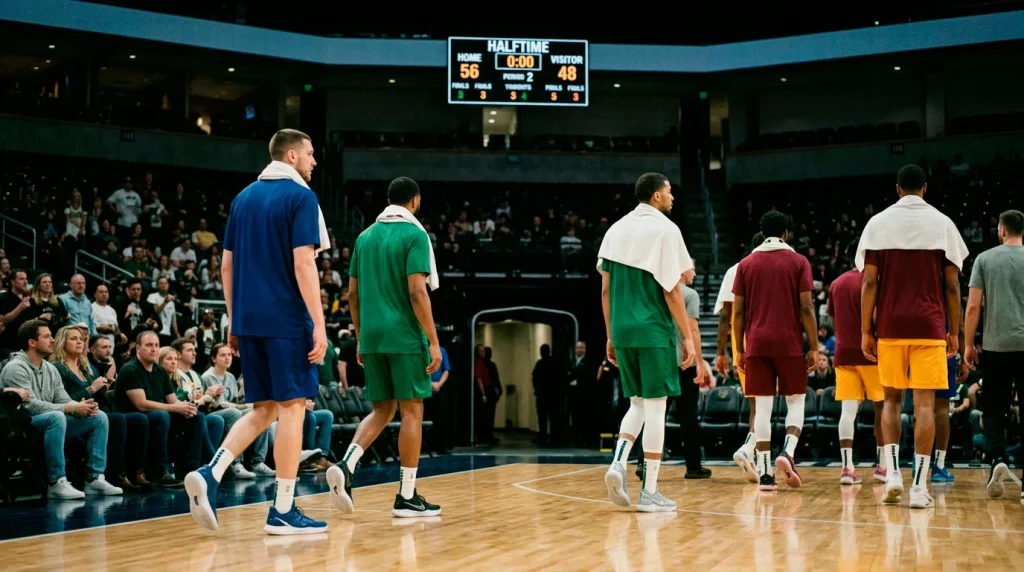
Double result bets — predicting both the half-time leader and the full-time winner — are one of the most underused markets in basketball betting. I started exploring them after noticing how many NBA games I correctly predicted at both checkpoints without realising there was a market for it. The odds are higher than a standard moneyline because you need to be right twice, but the analysis required is not twice as complex. It is a different kind of analysis, one that rewards understanding how teams perform at different stages of a game.
Double Result Markets: Maximizing Payoffs on Turnarounds
A halftime/fulltime bet requires you to predict two outcomes: which team (or a draw) leads at half-time, and which team wins the game. In basketball, this creates nine possible combinations: Team A / Team A, Team A / Draw, Team A / Team B, Draw / Team A, Draw / Draw, Draw / Team B, Team B / Team A, Team B / Draw, and Team B / Team B. In practice, the “draw” options at both checkpoints carry extremely long odds in basketball because tied scores at half-time and at full-time are rare — most games have a clear leader at the break, and ties at full-time lead to overtime rather than a draw.
The most commonly bet outcomes are the “straight-through” results: Team A leading at half-time and winning the game (A/A), or Team B leading at half-time and winning the game (B/B). The “turnaround” results — where one team leads at the break but the other wins — carry significantly higher odds because comebacks, while frequent in basketball, need to happen within a specific half-game window.
Settlement follows full-time rules: the half-time result is based on the score at the end of the second quarter, and the full-time result includes overtime if applicable. A game that is tied at the end of regulation and resolved in overtime is not a “draw” for full-time purposes — the overtime winner is the full-time winner.
Analysing Teams for Double Result Value
The key analytical skill for double result betting is separating teams’ first-half and second-half identities. These are not always the same. Some teams are built to dominate early and hold leads; others are structured to grind through the first half and turn up the intensity after the break.
Teams with dominant starting lineups and scripted opening offences tend to build half-time leads consistently. Their A/A double result price will be relatively short because the market recognises their pattern. The value here is limited because the bookmaker has priced the tendency into the odds. Where value appears is in the reverse scenario: a team that starts slowly but has a historically strong third quarter and fourth-quarter closer. Their B/A turnaround — trailing at half-time but winning the game — carries long odds because the market underweights the comeback probability relative to the half-time deficit narrative.
Coaching style drives double result outcomes more than raw talent does. A coach who runs set plays aggressively in the first half and adjusts conservatively in the second will produce different half-by-half profiles than a coach who grinds through the opening 24 minutes and unleashes his closing lineup in the fourth quarter. Understanding these coaching tendencies across a season of data gives you a framework for double result prediction that goes beyond simply looking at who is the better team overall.
The Turnaround Bet: When Comebacks Have Value
NBA comebacks from half-time deficits are more common than in almost any other major sport. A 10-point half-time deficit in basketball is roughly equivalent to a 1-0 deficit in football — concerning but entirely recoverable. Teams trailing by 10 at the break win outright approximately 20 to 25% of the time in the NBA regular season. That baseline recovery rate makes turnaround double results a viable market rather than a fantasy.
The highest-value turnaround bets occur when a strong team is expected to start slowly against a weaker opponent. If a top-five team has a documented pattern of trailing at half-time in road games against lower-tier opponents — perhaps because they conserve energy in the first half during a dense schedule — the B/A turnaround price is mispriced. The market sets the turnaround odds based on general comeback probabilities, but the specific team’s second-half dominance and the opponent’s tendency to fade in the fourth quarter create a higher comeback probability than the generic rate.
Back-to-back scheduling amplifies this effect. A team playing the second night of a back-to-back often starts sluggishly due to fatigue but, if they are the superior team, still has enough talent to overpower the opponent in the second half once they find their rhythm. The half-time deficit reflects the fatigue; the full-time result reflects the talent gap. The turnaround double result captures both dynamics in a single bet at enhanced odds.
Half-Time Markets as Standalone Bets
Beyond double result, UK bookmakers offer standalone half-time markets: half-time handicap, half-time total, and half-time moneyline. These settle on the score at the end of the second quarter and ignore everything that happens in the second half.
Half-time handicaps are approximately half the full-game spread, adjusted for first-half tendencies. A team with a full-game spread of -10 might have a half-time spread of -5 or -5.5. The adjustment is smaller than you might expect because half-time margins are slightly less predictable than full-game margins — the variance of 24 minutes of basketball is higher per minute than the variance of 48 minutes, which compresses the confident spread the bookmaker can set.
Half-time totals are popular among bettors who prefer the certainty of a shorter betting window. The typical NBA half-time total sits between 108 and 118, and the under has a slight historical edge because first-half scoring pace is marginally slower than second-half pace. Teams come out of the gate with tighter defensive schemes, the rotation has not yet deepened to include offence-heavy bench units, and the late-game fouling and pace acceleration that inflates fourth-quarter scoring does not apply to the first half.
I use half-time markets primarily as hedging tools. If I have a full-game bet that I want to partially protect, placing a half-time bet on the opposite side creates a natural hedge: if the first half goes against my full-game position, the half-time bet pays out and offsets part of the loss. If the first half aligns with my full-game bet, I lose the half-time hedge but my full-game position is in a strong state heading into the second half. This approach requires careful sizing to ensure the hedge does not eat too deeply into the full-game profit, but it reduces overall variance across the evening’s slate. For the full picture on how basketball bets are structured across different market types, the handicap betting guide covers the spread mechanics in detail.
Articles
Written by the editors at CourtEdge.
